Once Upon a Time I Used My Brain… Now I Use AI Tokens
Part 1: How AI, Screens, and Modern Life Are Quietly Eroding Your Brain

2025 was about "Use AI."
2026 is about "How to Use AI" — before your brain quietly files its resignation.
There was a broken escalator at a mall near my house. Every time it stops working, I watch people gather at the bottom, look up, and then — I kid you not — walk around looking for another escalator. Not the stairs. Another escalator. As if their legs had filed a formal complaint against climbing.
I used to laugh at this. Then one day, I caught myself doing the same thing. Not at a mall. At work. My AI agent had gone down — some API timeout — and I sat there staring at my screen, genuinely unsure how to start the task I'd been doing for fifteen years.
That was my escalator moment. And if you're honest with yourself, you've probably had one too.
The Slow Boil: Smartphones to AI Agents
Let's rewind the tape.
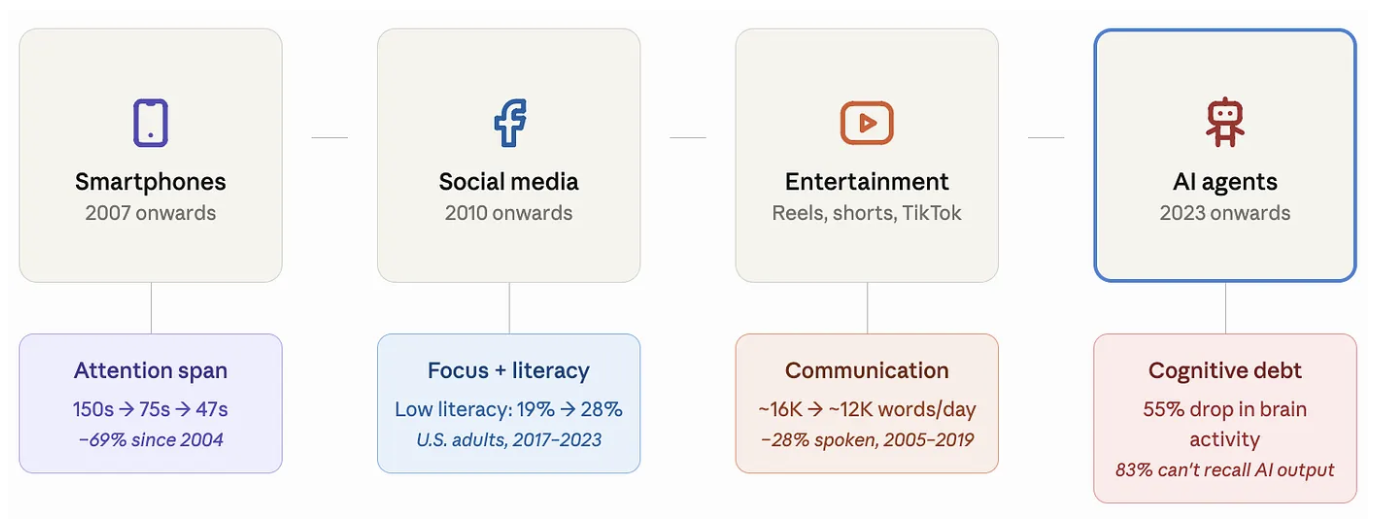
First came smartphones. Then social media — Facebook, Instagram, the usual suspects — designed not to connect us but to keep us scrolling. Then YouTube, Netflix, TikTok, each one more algorithmically addictive than the last. And somewhere along the way, our attention spans collapsed.
In 2004, the average attention span on a screen was about two and a half minutes. By 2012 — right when smartphones went from luxury to oxygen — it had halved to 75 seconds. By 2020, it was down to 47 seconds [1]. That's not a decline.
Our children are the worst hit. Short-form content has trained an entire generation for 30-second focus intervals. They can't maintain attention for 10 minutes, let alone an hour. Children are not growing — they're buffering. Loading endlessly, rendering nothing. And the percentage of adults with "low literacy" rose from 19% in 2017 to 28% in 2023.
That's not a stat. That's a siren.
But here's what we told ourselves: "It's just entertainment. I can still focus at work. I'm a knowledge worker, after all." We drew a neat little line between the personal screen time and professional cognitive ability, and we felt safe on our side of it.
Then AI crossed that line.
It entered our workplaces in the form of LLMs, coding agents, and AI assistants. And suddenly, the same brain that was already struggling to watch a 10-minute YouTube video without checking WhatsApp was now outsourcing its thinking to a machine. Not just googling — thinking.
Welcome to the age of cognitive offloading. Or as I like to call it:
The Colleague Who Couldn't Answer His Own Code
Let me tell you a story.
A colleague of mine — hard working, good engineer — pushed some code to GitHub and asked me to review it. Standard stuff. I went through it, had a few questions about the design choices, and pinged him. Nothing fancy. Just "why did you do X here instead of Y?"
He paused. Then said, "Give me a minute."
He went to his IDE — Windsurf, powered by an AI agent — typed my questions there, got the AI's answers, and forwarded them to me. Word for word.
Now, it's not that he'd lost his ability to think. He's a capable engineer. But something had shifted. The reflex to think first, then answer had been replaced by a reflex to ask the AI first, then relay. The AI had become his mental spokesperson. And when you need a spokesperson for your own thoughts, something's gone quietly, terribly wrong.
This isn't an isolated case. I see it everywhere. People running four AI conversations in parallel, "multitasking" their way through the workday, and at the end of it, unable to explain what they built or why.
Is AI Making You Stupid? The Five Layers Deep
When I gave a talk on this topic at a session recently, I opened with what seemed like a simple problem — AI is making us a little lazy. Top-level stuff yet shallow. But as I peeled back the layers, the room got quiet. Because the real problems live deeper.
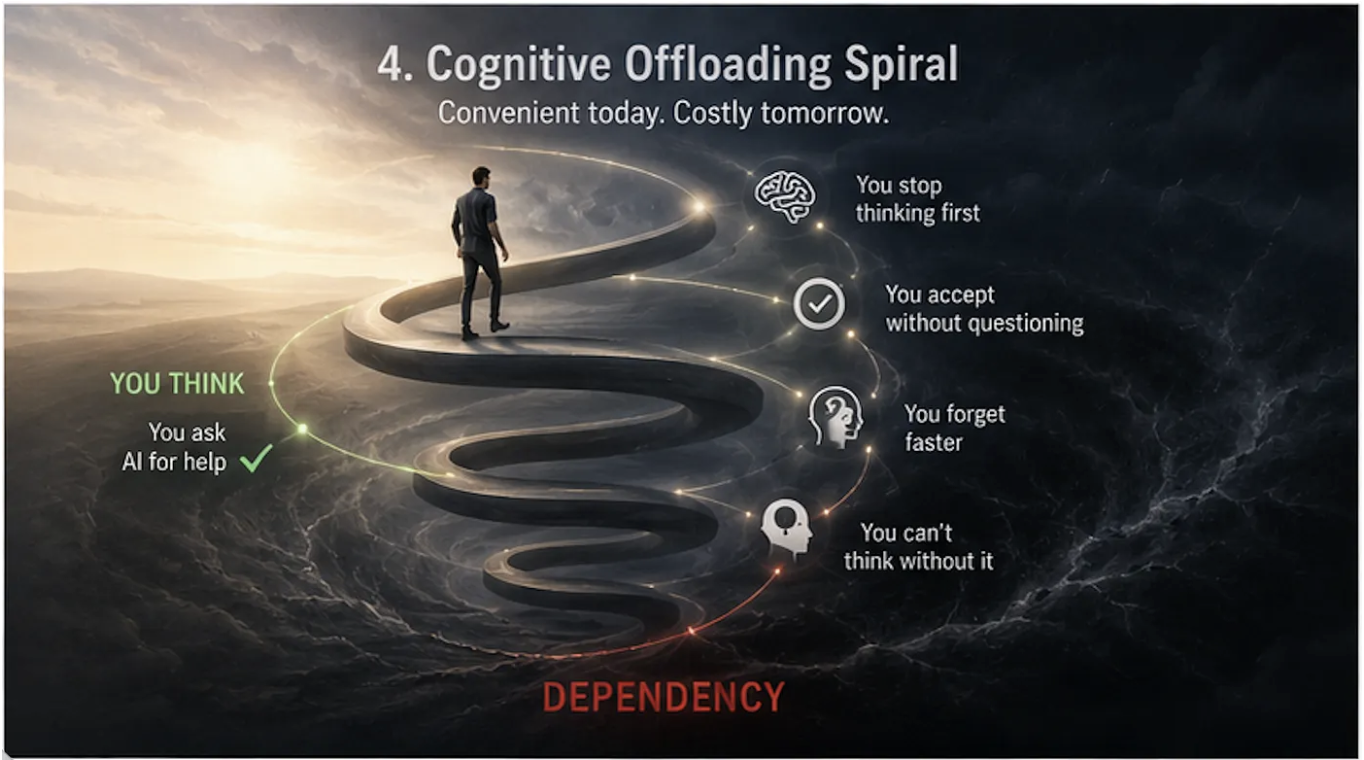
Cognitive offloading is the surface. You delegate the thinking to the AI. "Fine," you say, "I'm being efficient." But beneath that lies cognitive surrender — where you stop even trying to think before reaching for the AI. Offloading is a choice. Surrender is a habit. And habits are invisible running on autopilot.
Go deeper still. Flattening originality — AI-generated code, emails, summaries, essays, they all start sounding the same. The human voice disappears. Not because AI is bad at writing, but because when everyone outsources to the same machine, originality becomes the first casualty. The MIT study actually confirmed this: AI-assisted essays showed less linguistic diversity and more homogenized prose [2].
Then there's eroding judgement. When you stop exercising critical thinking, the skill doesn't wait patiently for your return. It fades. Like any unused muscle, it atrophies. And the cruelest part? You don't notice the decay because the AI's output looks great. The PowerPoint is beautiful. The code compiles. Your manager starts liking your mail replies! The email reads better than anything you'd write. So you stop questioning it. A bidirectional sycophancy — first the AI kept nodding to what we said, then we just nodded back to the AI!
And finally: multitasking as an accelerant. Five browser tabs, three AI agent windows, Slack pinging, a meeting in the background. You think you're being productive. But your brain isn't multitasking — it's frantically switching, burning energy on every transition, doing each task worse than if you'd done it alone. The more you "multitask" with AI, the more exhausted your brain gets, and the more it surrenders to the next AI suggestion without a second thought.
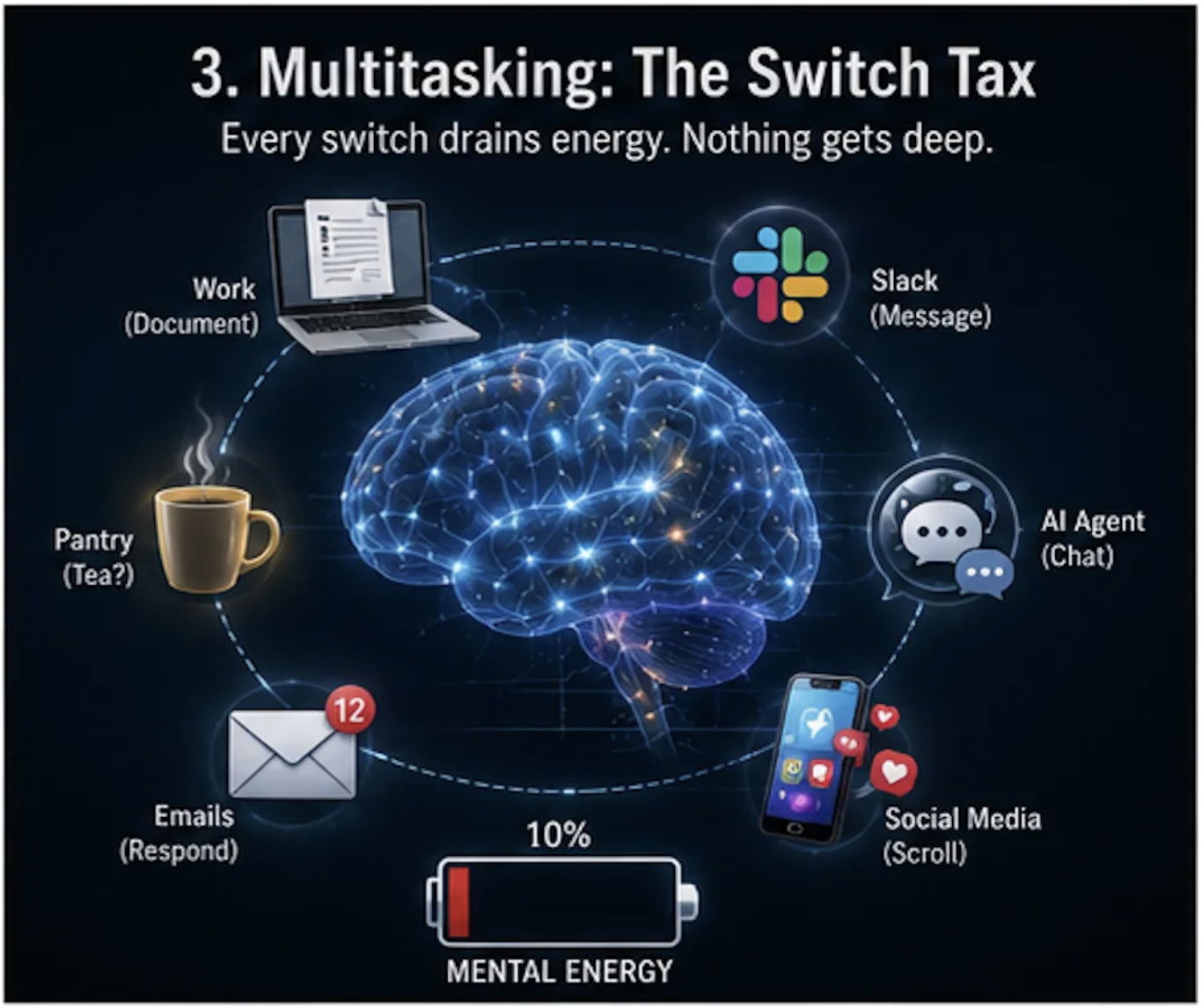
Here's the punchline from my talk that hit hardest:
We love judging other people. We'll critique a colleague's work, question a vendor's proposal, argue with our spouse about the right way to load a dishwasher. But when AI hands us an answer? We nod. We accept. We ship. We judge everyone — except the AI.
The Numbers Don't Lie (But Your Brain Might 😉)
If my stories feel anecdotal, the research is anything but.
A 2025 MIT Media Lab study tracked 54 university participants using EEG monitors across 32 brain regions as they wrote essays — one group with ChatGPT, one with Google, and one unaided. The AI group showed a 55% drop in brain engagement compared to manual writing. They finished 60% faster — and 83% of them couldn't recall what they'd just "written" minutes later. The researchers called this:
Most strikingly, when the ChatGPT group was later asked to write without AI, they struggled to re-engage the neural networks they'd been bypassing. The offloading mindset persisted even after the tool was removed [2].
A study by Michael Gerlich (2025) at SBS Swiss Business School used surveys and interviews with 666 participants across diverse age groups and found a significant negative correlation between frequent AI use and critical thinking ability. The more people leaned on AI, the less capable their own reasoning became. Younger users (ages 17–25) were hit the hardest — the very demographic most enthusiastically adopting these tools [3].
Microsoft's own 2025 Work Trend Index, based on a survey of 31,000 knowledge workers and trillions of Microsoft 365 telemetry signals, revealed that employees are interrupted on average every two minutes during core work hours — 275 times a day — by meetings, emails, or chats. 80% of workers report lacking the time or energy to do their jobs effectively [4]. Cal Newport's "deep work" isn't dying — it's already dead.
And here's one more number that keeps me up at night: we lose two-thirds of newly learned information every single day [5].
Now imagine what happens when the AI does the learning for you. You don't just forget faster. You never form the memory in the first place.
Here's the uncomfortable truth: we're building a generation of knowledge workers who produce excellent output they don't understand, can't defend, and wouldn't recognize if it were read back to them.
The Silicon Housemaid: Spotless Results, Bitter Debt
I have a domestic help at home — a wonderful person who takes care of cleaning, cooking, and laundry. One day I realized: if she stopped coming for a week, our household would genuinely struggle. Not because we're incapable. But because the muscles of daily maintenance — the cooking instinct, the cleaning rhythm — had quietly gone slack.
AI at work is becoming the same thing. A silicon housemaid. The results are spotless. The code compiles. The reports are formatted. The emails sound smarter than you. But underneath the shiny output, your cognitive muscles are wasting away.
And the debt compounds. Think about what happens when the power goes out, the internet drops, or the AI provider has an outage. Remember the Microsoft global outage in 2025? The world didn't just slow down — it stopped. Airports grounded, hospitals disrupted, businesses frozen. We've connected ourselves so tightly to digital infrastructure that a single point of failure can paralyze millions. Now imagine that same fragility, but for your mind.
And just like ultra-processed food gives you calories without nutrition, AI-generated work gives you output without understanding. Digital content — reels, shorts, rage bait — has become the junk food of the mind.
High in instant gratification. Low in cognitive nutrition.
In Part 2, I share The Future-Proof Human Playbook — practical strategies for using AI at work without losing your mind (literally), and the habits that protect your brain at home. Because the problem isn't AI. The problem is what happens when we stop thinking alongside it.
References
[1] Mark, G. (2023). Attention Span: A Groundbreaking Way to Restore Balance, Happiness and Productivity. Hanover Square Press. Research conducted at University of California, Irvine, tracking screen-focus duration from 2004 to 2020.
[2] Kosmyna, N., Hauptmann, E., Yuan, Y.T., et al. (2025). "Your Brain on ChatGPT: Accumulation of Cognitive Debt when Using an AI Assistant for Essay Writing Task." MIT Media Lab. arXiv:2506.08872.
[3] Gerlich, M. (2025). "AI Tools in Society: Impacts on Cognitive Offloading and the Future of Critical Thinking." Societies, 15(1), 6. DOI: 10.3390/soc15010006.
[4] Microsoft (2025). "Breaking Down the Infinite Workday." Work Trend Index Special Report. microsoft.com/worklab.
[5] Ebbinghaus, H. (1885). Über das Gedächtnis (On Memory). The "forgetting curve" — approximately 67% of newly learned information is lost within 24 hours without active reinforcement.
[6] Wilson, T.D., et al. (2014). "Just think: The challenges of the disengaged mind." Science, 345(6192), 75–77. (Referenced in Part 2.)