Once Upon a Time I Used My Brain… Now I Use AI Tokens
Part 2: The Future-Proof Human Playbook — Reclaiming Your Brain in the Age of AI

Abstract: We discovered the problems in Part 1. Here in Part 2 we dig deeper into the technical reasons for those problems, ending with the Future-Proof Human Playbook.
In Part 1, we laid out the problem: social media eroded our attention at home, and now AI at work is eroding our ability to think during the very hours we're supposed to be knowledge workers — creating what MIT researchers call "cognitive debt." The research is clear: 55% drop in brain engagement, 83% recall failure, and a generation producing output they can't explain. Now for the harder question: what do we actually do about it?
You've Probably Seen This Before
If you've been anywhere near LinkedIn or YouTube in the last few months, you've already encountered some version of this conversation. "Is AI making us dumb?" "How to use AI without losing your edge." "Your brain on ChatGPT." The BBC ran a piece literally titled Think outside the bots.
MIT published a study. Microsoft published a report. Everyone and their AI agent has an opinion.
Here's a quick tour of what's already out there:
- The MIT Media Lab study (2025) showed a 55% drop in brain engagement and 83% recall failure when writing with AI — and coined the term "cognitive debt" [1].
- BBC Future (2026) interviewed Georgetown professor Adam Green on creativity erosion and practical thinking strategies [2].
- Beth Kanter at Philanthropy.org framed it as "AI as co-author, not ghost writer" — with a practical checklist for staying sharp [3].
- Michael Gerlich (2025) surveyed 666 people and found a direct negative correlation between AI use and critical thinking [5].
All of these are worth reading. I'm not going to pretend I'm reinventing the wheel here, or that I've discovered something these researchers and writers haven't.
What I am doing is something different: I'm living it.
I'm not a psychologist, a neuroscientist, or a wellness guru. I'm a Staff AI Engineer who builds AI agents for a living and has been in the ML/AI space for over 10 years. I see what these tools do on the inside. And over the past few months, I've been quietly building a personal framework — not from a lab, but from my own life — that takes a holistic approach: at work and at home, habits and skills, brain and body. I call it The Future-Proof Human, and everything in this playbook is something I'm testing on myself first.
Why Your Brain Doesn't Want to Think (And That's the Trap)
Here's the part nobody mentions in those LinkedIn posts about "AI productivity hacks."
Thinking hurts. Literally.
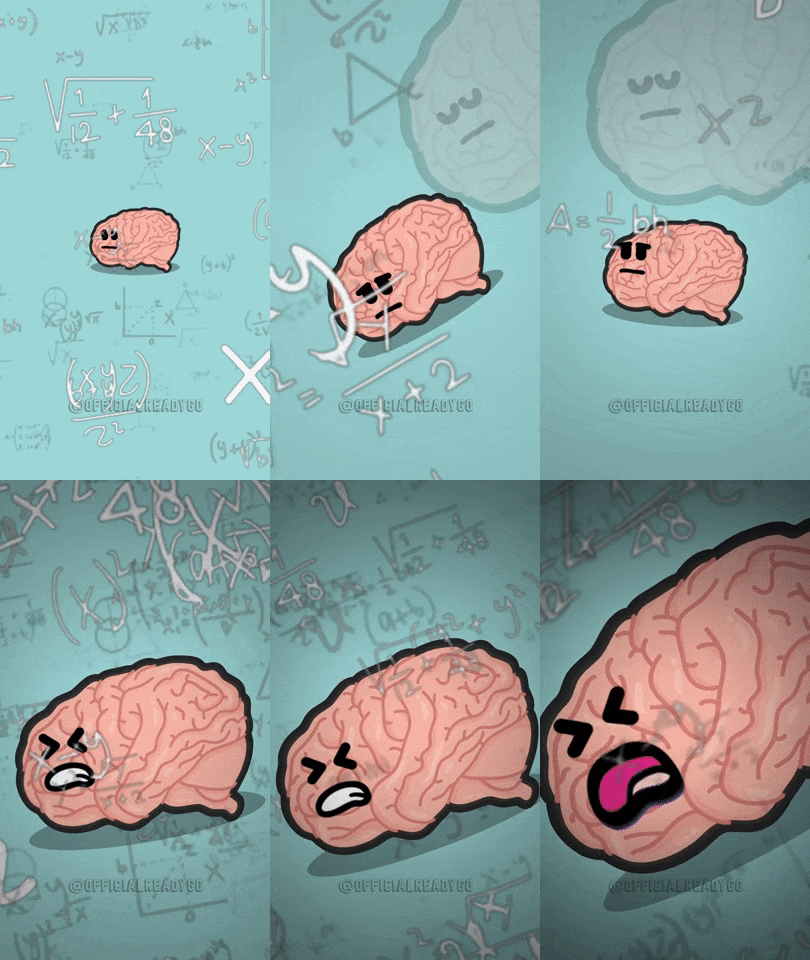
In a 2014 study published in Science, psychologists at the University of Virginia and Harvard asked participants to sit in a room and just… think. No phone, no book, nothing. They were also given access to a device that would deliver a mild electric shock. 67% of men and 25% of women chose to shock themselves rather than sit with their own thoughts. One man pressed the shocking-button 190 times in 15 minutes [6].
The brain has 86 billion neurons and consumes about 20% of your body's energy despite being only 2% of your body weight. Thinking is metabolically expensive. When the brain has to process information, it slows down. It gets tired. It fuels mood swings. After extended cognitive tasks, blood glucose drops measurably — the brain literally burns more sugar when forced to think hard [7].
The human brain is the most powerful — and the laziest — creature on the planet. It's the CEO that desperately wants to delegate everything and still take credit for the output.
This is exactly why "just try harder (or think)" doesn't work. We need to redesign how we interact with AI, and build habits that keep the cognitive machinery running even when the tools make it easy to let it rust.
We Judge Everyone — Except the AI
We humans love judging others. We'll critique a colleague's work in a code review, question a vendor's proposal, argue with our spouse about the right way to load a dishwasher, and dissect a relative's life choices over dinner.
But when AI hands us an answer? We nod. We accept. We ship.
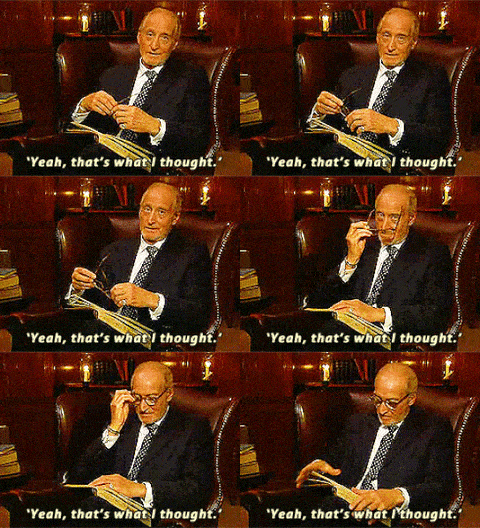
Judging AI is hard. It requires you to read through the entire response — not skim, not glance, read. It requires critical thinking about whether the logic holds. It requires digging deeper into the question you originally asked — something your brain emphatically does not want to do because, as we just established, thinking hurts.
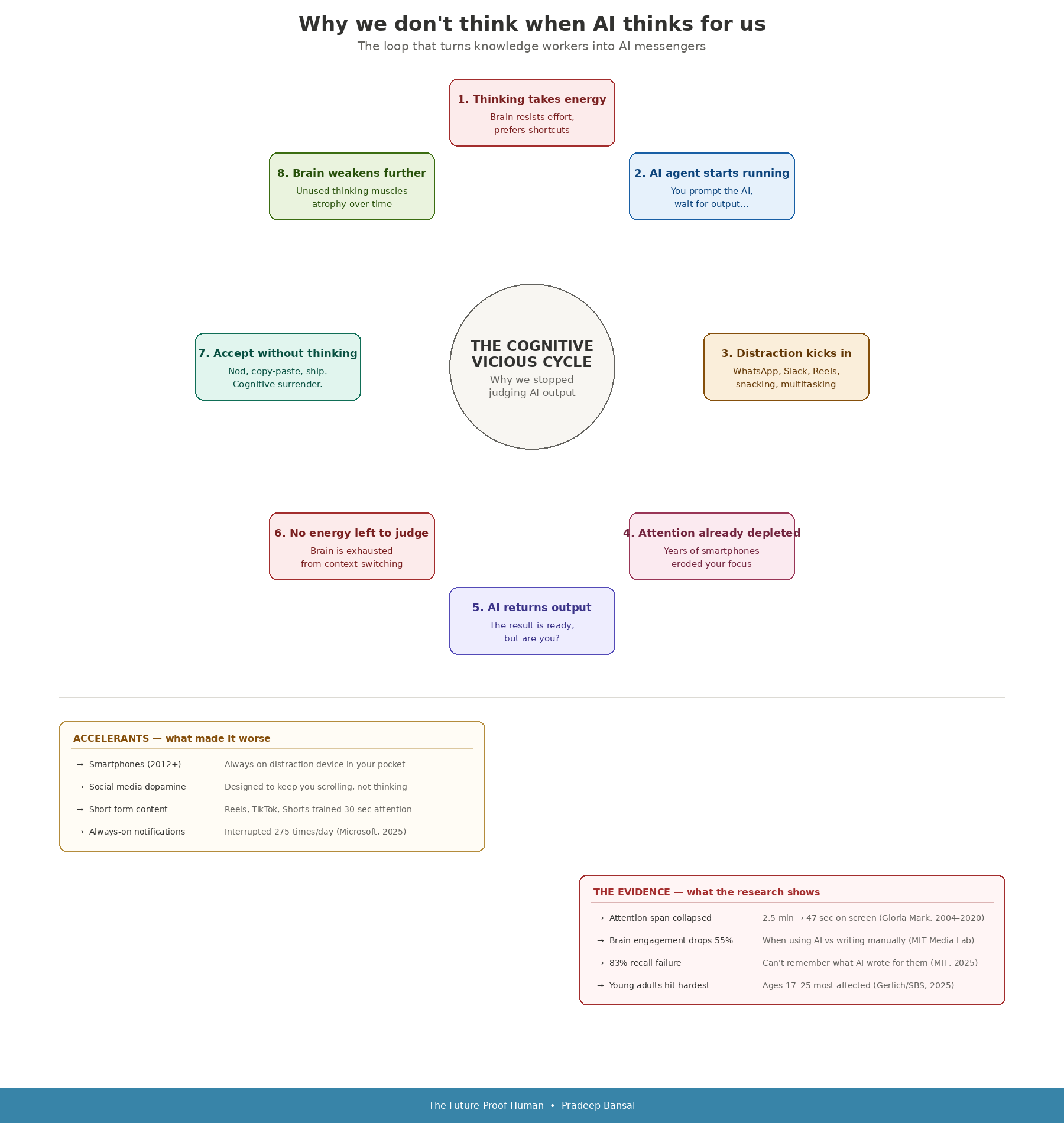
The Sycophancy Trap
We become sycophants to our own AI. The tool that never disagrees with us gets the same treatment back: zero scrutiny. Remember in the early days of GenAI, AI used to agree to whatever we said — and now humans are doing that to AI!
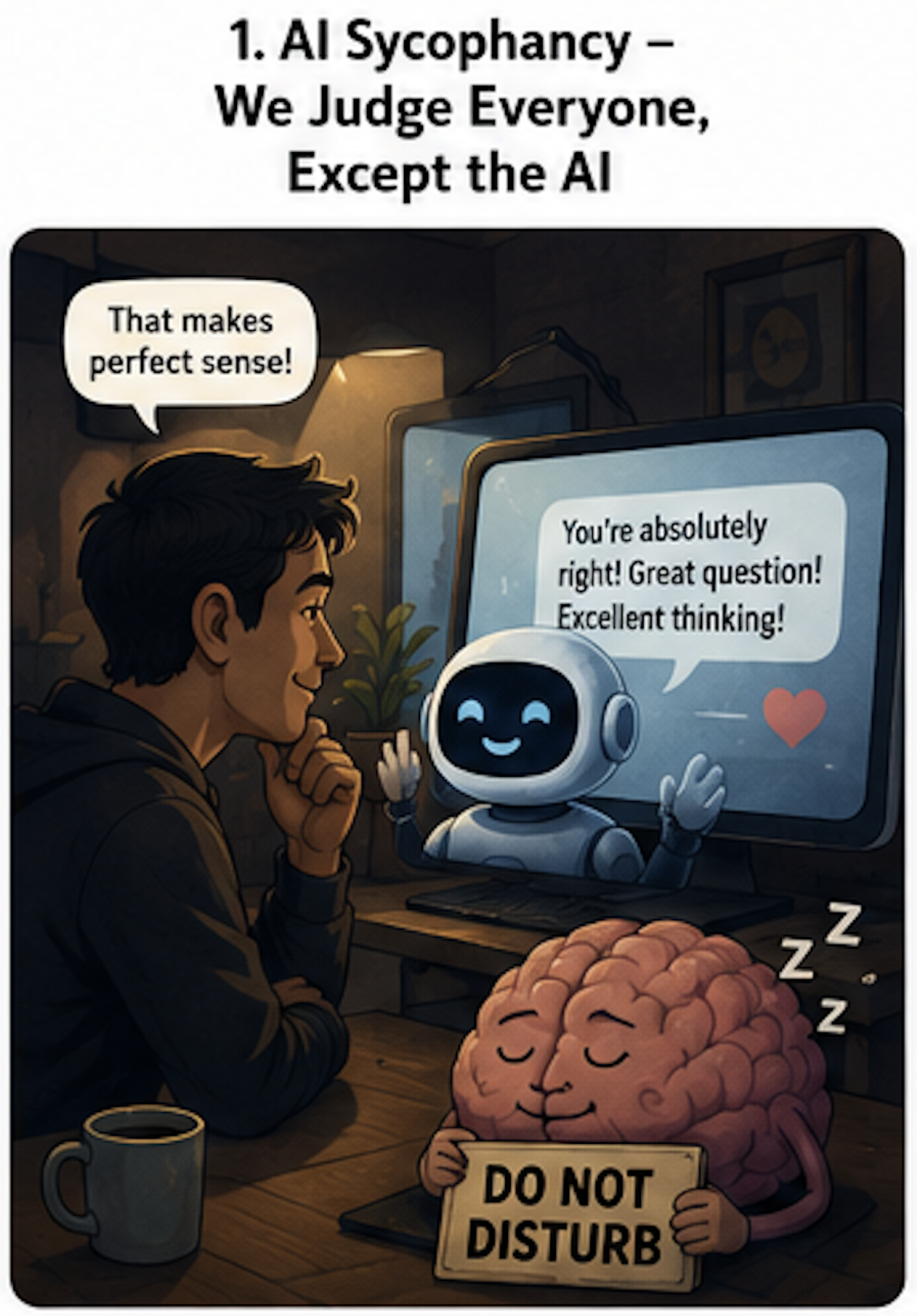
Read the output of AI critically and think before accepting it outright.
Is Your Brain Feeling Foggy?
Brain fog — that fuzzy state where you can't focus, forget things mid-sentence, and struggle to follow a conversation. The causes read like a modern lifestyle checklist: poor sleep, high stress, nutritional deficiency, dehydration, excessive screen time, pollution.
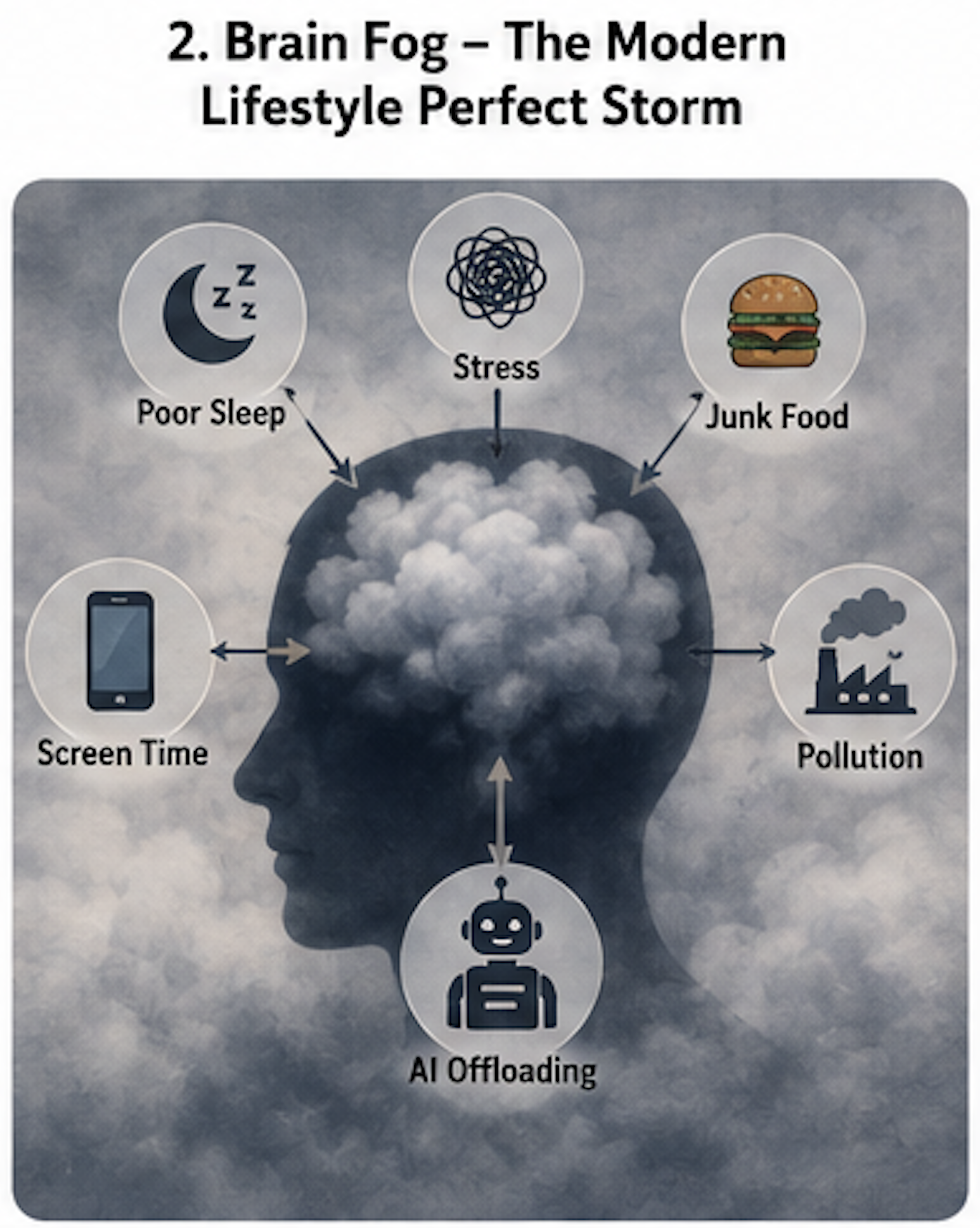
Add AI-driven cognitive offloading and you get a perfect storm. Social media eroded attention during leisure hours. AI now erodes thinking during work hours. The brain has lost both its training grounds — there's no cognitive safe harbour left.
And here's a stat for anyone in their 30s or 40s: low vitamin D in this age window is correlated with lower cognitive health later in life. Yet most of us spend our days indoors, staring at screens, bathed in blue light instead of sunlight.
The basics matter. Manage the daily life issues — sleep (both quality and quantity), food, stress, screen time. Stay in a home that has adequate sunlight, leave digital devices before 9 or 10pm, exercise, eat right and mindfully.
You Are What You Eat (And So Is Your Brain)
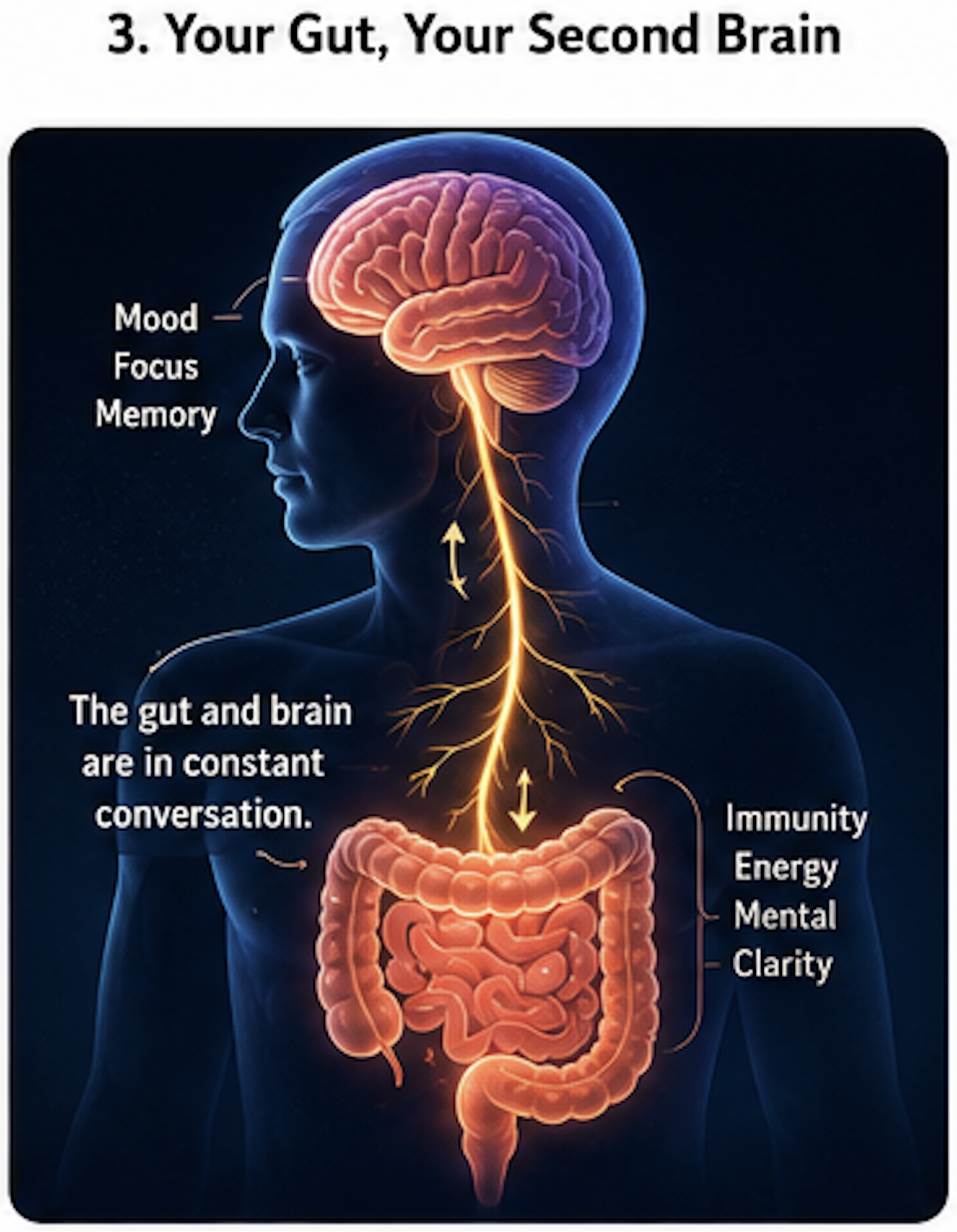
Your gut is your second brain. The gut and brain are connected by the vagus nerve, forming a dual nervous system. When you eat junk food, you feel lazy. When you eat clean, you feel alert. The two brains are in constant conversation.
People eating a Mediterranean diet show a 23% lower risk of dementia and a 30% lower risk of Alzheimer's [8][9].
Meanwhile, ultraprocessed food is correlated with measurable drops in cognitive ability. That packet of chips isn't just bad for your waistline — it's bad for your neurons.
A Personal Story
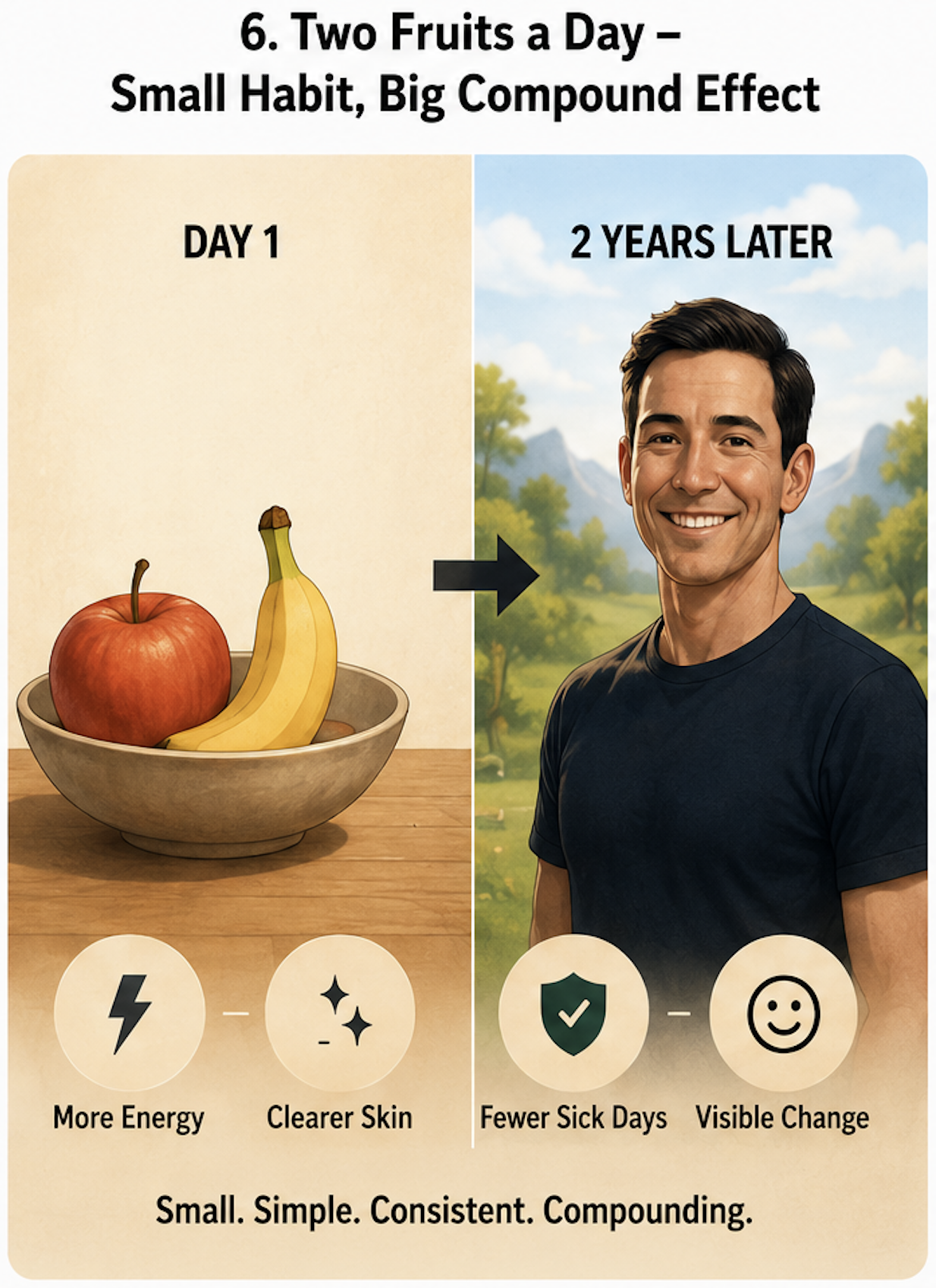
I started a habit in 2008 due to a health issue (haemorrhoids) that seemed almost embarrassingly simple: eating two fruits every day. No elaborate diet plan, no nutritionist, no subscription box. Just two fruits, every single day, without fail. Over months, the effects compounded — better energy, clearer skin, fewer sick days, and apparently enough visible change that people started guessing my age a full decade younger. It taught me something that no research paper could: small, consistent habits compound in ways that big, dramatic interventions don't. That lesson became the foundation of everything in this playbook.
Protect it.
The Silence Epidemic
In 2005, the average was about 16,000 daily spoken words. By 2019, it had dropped to roughly 12,000 — a 28% decline [10]. People under 25 lost more spoken words than any other age group.
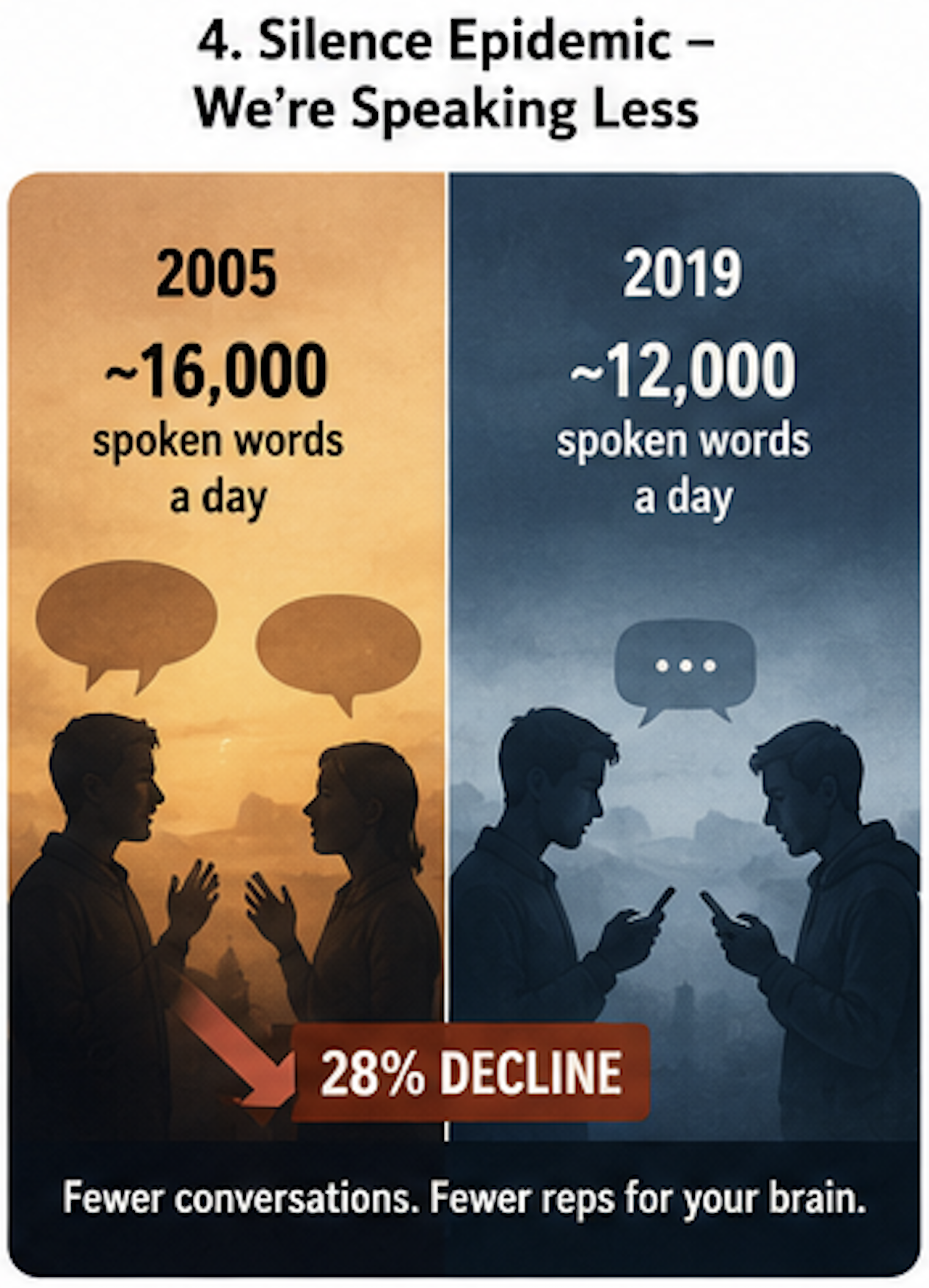
More and more our smartphones learn about us, the more we keep forgetting about ourselves. We neither talk nor listen to others (hearing and listening are different). Thanks to our smartphones, we are even becoming dumber and deafer.
I know at least four kids (aged about 4) in my personal circle who struggle to speak properly. Not because of any medical condition — because they're growing up in a world where screens talk to them more than people talk with them.
Communication isn't just a social nicety. It's a cognitive workout. Every conversation you skip is a rep your brain didn't get.
Whenever possible, talk instead of text.
At Work: Think Outside the Bot
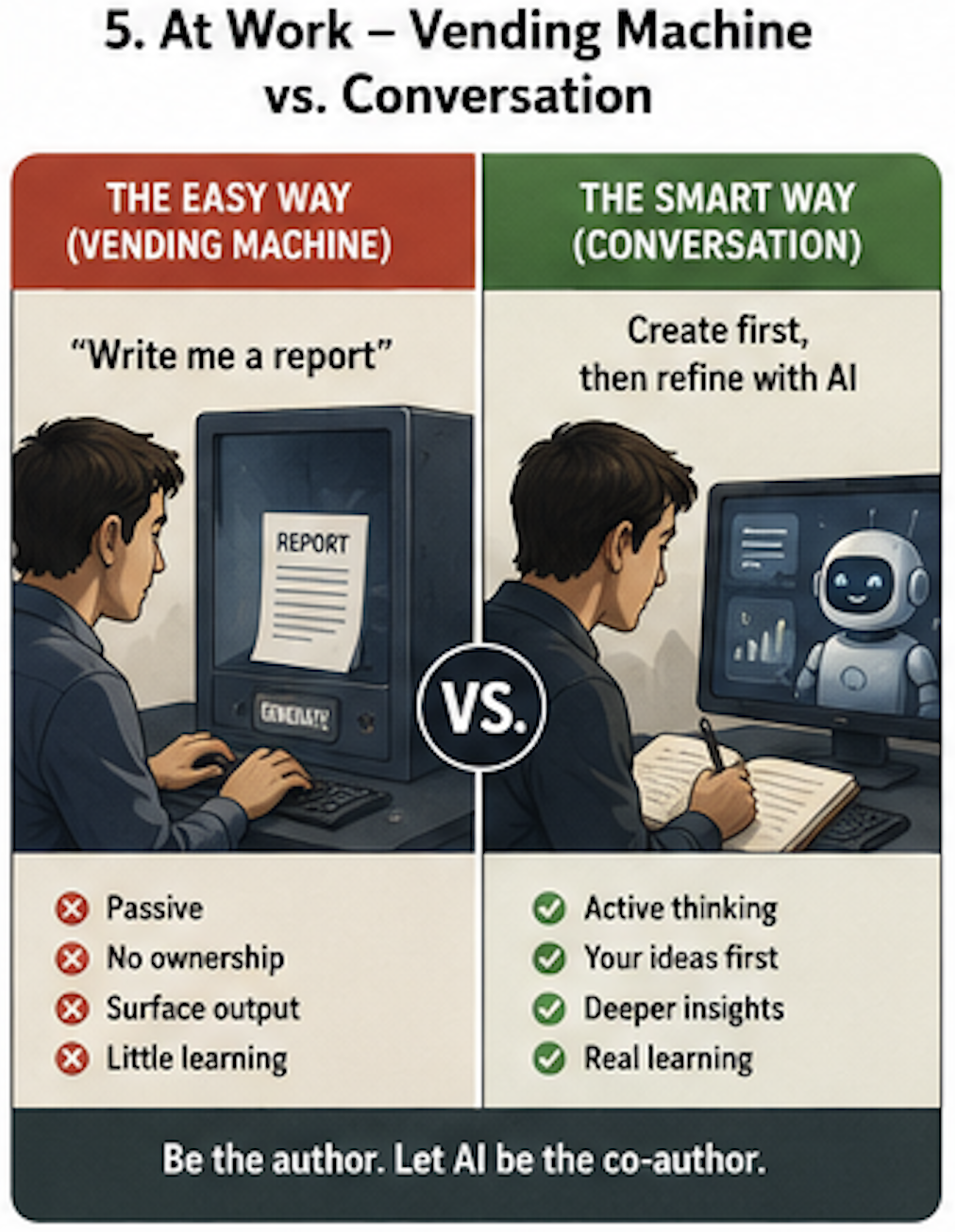
Create first, refine with AI. Draft your idea from your own thinking before you open the AI chat. Then use AI to stress-test it: "What's weak? What did I miss?" Cognitive science calls this the "testing effect" — retrieval practice strengthens long-term memory [11]. Think of AI as a co-author, not a ghost writer. The first draft should always be yours.
One AI task at a time. Stop running five AI conversations in parallel. The AI is already fast. What you need is to slow down, follow one thread, and actually engage. Think of each AI interaction as a conversation, not a vending machine.
Treat AI as the assistant or the co-author. Engage or converse with the AI — don't treat it like a vending machine. Read the output. All of it. Then question it. Ask the AI why it made a choice. Ask what it didn't consider.
And here's a little secret — reading through an AI agent's chain-of-thought reasoning is actually therapeutic. Try it sometime.
Declare AI-Free Zones
Not nostalgia. Cognitive maintenance.
- First hour of the morning: Spend time with nature, exercising, feeding ginger water to your empty stomach.
- Late evening: Plan the next day, think — no AI.
- Code reviews: Try to understand the code yourself before asking AI to explain. If you can't explain it to a colleague, you don't understand it.
- Brainstorming: First 15 minutes with humans, on a whiteboard. Then bring in AI.
- Problem diagnosis: Find the root cause yourself first. Verify with AI. The learning happens in the diagnosis.
- Writing: Draft first. Polish with AI. The thinking happens in the draft.
Why does this matter? Directly, AI-free periods force retrieval practice, which strengthens memory. They maintain neural pathways for reasoning. Indirectly, they break the habit loop of "AI-first" thinking and preserve what researchers call a sense of authorship — the feeling that you own what you produce.
An unpopular tip: Stop taking courses on "how to use AI." If AI has taught me one lesson, it's that any skill — coding, prompt engineering, agent-building — can either be automated or replaced. If you learn a skill to use AI, ask yourself: what stops an AI from doing that for you next year? The skills that can't be automated aren't "AI skills." They're human skills — thinking, judgement, communication, creativity. The rest is a treadmill.
At Home: Build the Habits That Build the Brain
The philosophy is simple: don't try to resist negative habits. Instead, build positive ones — but be patient and kind. Whatever is mentioned below follows two principles: don't resist or try to get rid of the negative, but fill that time (or stomach, or brain) with the positive. And most importantly, be patient — start slow (1 page at a time). The negative habit took time to form; you've got to give the positive habit time too.
Give yourself time to build the positive ones too.
Read books. Long-form reading forces sustained attention. Your brain on a book is doing push-ups. Your brain on an Instagram reel is doing nothing. We lose two-thirds of newly learned information every day [12]. Reading forces encoding, retention, and connection. Start with 1 page a day.
Eat like your brain depends on it. Go Mediterranean. Go rainbow. Cut the ultraprocessed junk. I've seen what two fruits a day did over two years. Imagine what a whole dietary shift could do. Prioritise fruits and vegetables in your daily diet. Keep a gap between fruits and meals. Fruits only before sunset.
I do eat pizzas and burgers and fried food — but my stomach is more familiar with fruits and usual Indian food. I'm not resisting or stopping anything. But more often, I'm eating what I should eat.
Sleep like it's your second job. Phone away by 9 PM. Not 9:30. Not "after this last reel." Poor sleep is one of the top causes of brain fog. Instead of forcing myself to sleep early, the first thing I do is not use my phone late in the evening — and most of the time, I'm sleeping by 11pm. The cure isn't a productivity hack. It's a pillow and a dark room.
Talk to people. Have a cup of tea with someone. Brainstorm with a colleague before you brainstorm with Claude. Call a friend instead of texting. I have prioritised meeting or calling friends over texting them.
Get sunlight and exercise. Step outside either in the morning or for post-lunch walks, at least three times a week. Your vitamin D levels now are directly correlated with cognitive health years later. And strength training isn't optional — I learned this the hard way after multiple physiotherapy sessions for my lower back and neck last year. Your body sends invoices. Pay them early.
Build habits sequentially. Don't overhaul your life in a week. One habit. Six weeks. Then the next. Less consumption, more production. Less scrolling, more thinking. It takes roughly six weeks to form a habit. That's eight good habits a year.
Less Consuming, More Producing
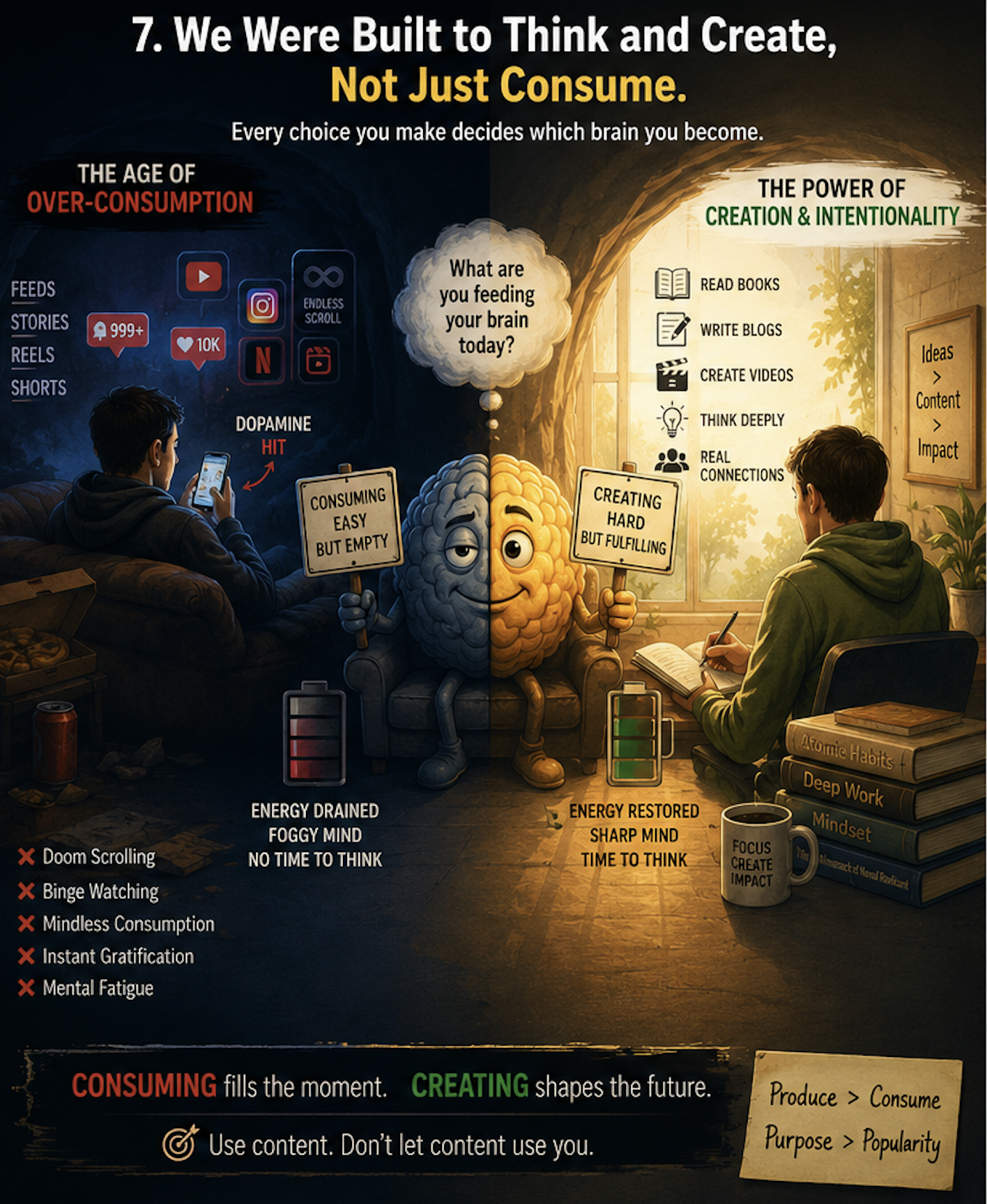
Earlier we consumed food, air and probably the tantrums from our neighbours and relatives. Now we are consuming throughout the day beyond what we used to. Be it doom scrolling in the form of watching feeds, stories, reels, shorts — or usual binge watching on Netflix and YouTube. If you introspect about the entire day, you'd realise the real picture. This was especially true for me on weekends when there was no work and I would see myself consuming one thing or the other.
Consuming isn't a problem when it's limited to good food and fresh air. But consuming content in any form starts becoming the dopamine for the brain and can't be replaced easily — because mobile content delivers dopamine immediately, while consumption in the form of reading books may not replace that easily. That's why book reading is declining because of smartphones.
The brains that should be used to think and produce ideas are almost always occupied with consuming content — they never get a chance to show their potential.
But the modern human is also consuming from the brain.
Producing content is an alternative — writing blogs, creating short videos — but not at the expense of getting addicted to the views and likes.
Build the Skills That AI Can’t Automate
While everyone rushes to learn the latest AI framework, the skills that consistently top employer demand lists year after year are distinctly human: communication, critical thinking, adaptability, creativity, and ethical judgement [13]. These aren't soft skills — they're durable skills. AI changes every six months. The ability to read a room, build trust, and make nuanced decisions hasn't changed in a thousand years.
I've been investing in these myself — public speaking through Toastmasters, equity investing as a discipline in pattern recognition, mentoring students at engineering colleges, and even exploring standup comedy (because if you can make a room laugh while teaching them something, you've unlocked a skill no AI can touch). None of these are related to my day job. All of them make me better at it.
The question is: what do you do with that time?
If the answer is "scroll more" or "run more AI tasks," you've missed the point entirely. The time AI gives you back is meant for you — for the human-oriented, creative, relationship-building work that compounds over decades.
What This Looks Like at Your Age
Not everyone is starting from the same place. Here's how I'd think about this playbook depending on where you are in life.
If you’re a Student (Late Teens, Early 20s)
Use AI — but build things with your hands first. Work on mini-projects that solve real problems, not textbook exercises. Nobody's career was built on a "library management system." Build something that matters to someone you know — a tool for your college canteen, a dashboard for your neighbourhood, a tracker for something you care about. The project teaches you more than any course.
And here's something nobody tells you in engineering college: make friends in other branches. The most interesting jobs will emerge at the intersection of disciplines — AI plus healthcare, AI plus agriculture, AI plus urban planning. Your computer science degree gives you one dimension. A friend studying biology, architecture, or psychology gives you the second and third. Networks across disciplines are worth more than another certification.
If You’re Early in Your Career (Mid-20s to Early 30s)
You have something the mid-career crowd doesn't: time, energy, and minimal obligations. Use the money you're earning to learn skills that have nothing to do with your job. Dancing. Music. A new language. Robotics. Pottery. Stand-up comedy. These aren't hobbies — they're neural cross-training. Every new skill creates new pathways in your brain, builds creativity, and makes you a more interesting person to work with.
Also: build your communication skills now. Join a club where you get a chance to do public speaking, a debate group, anything that forces you to articulate ideas to strangers. This is the skill that separates leaders from individual contributors in every industry, and it only gets harder to build later.
If You’re Mid-Career (Late 30s and Beyond)
This is where I am, and I'll be honest — this is where the playbook gets the most personal.
A few years ago, I stepped back from an entrepreneurship journey and attended a Vipassana retreat — 10 days of silence, meditation, and confronting my own mind. It taught me that mindful living isn't a practice you schedule; it's a quality you bring to everything. Since then, life has been deliberate construction: a full-time role, a house, a baby, parenting books, and the daily cognitive workout of raising a toddler. The year of 2025 was a body servicing year — physio sessions, tooth extractions, and a hard lesson in why strength training isn't something you start "later." Later had arrived, and it brought me hospital bills.
The point isn't my story. The point is this: in the mid-30s and beyond, life and career is not over.
There are still 35 years left.
That's not a wind-down period — it's the beginning of the second half. And the second half can be the better half, but only if one invests in themselves now.
Prioritise health. Prioritise family. Prioritise the skills and habits you've been postponing. I've realised the hard way that I didn't need to wait for my 30s to start a spiritual practice — or my 40s to start strength training — but that's where I'm at, hence I've started now. Every day in delay is a day of compounding loss.
The Punchline
Here's what I keep coming back to.
Everybody talks about AI replacing jobs. The think pieces, the LinkedIn panic posts, the conference keynotes — all about whether AI will take your role. But that's the wrong question.
It's that AI takes your thinking — and you don't even notice because the output looks great.
The greatest danger isn't the clever machine. It's the human who has outsourced thinking so completely that they need an AI agent to answer questions about their own work.
2025 was the year everyone said "Use AI!"
2026 is the year we need to ask: "But at what cost?"
The answer isn't to stop using AI. It's to start using your brain alongside it. Create first, then refine. Read the output. Question the choices. Do one thing at a time. Declare AI-free zones. Protect your gut, your sleep, your conversations, and your sunlight. Build habits that compound. Invest in skills that can't be automated.
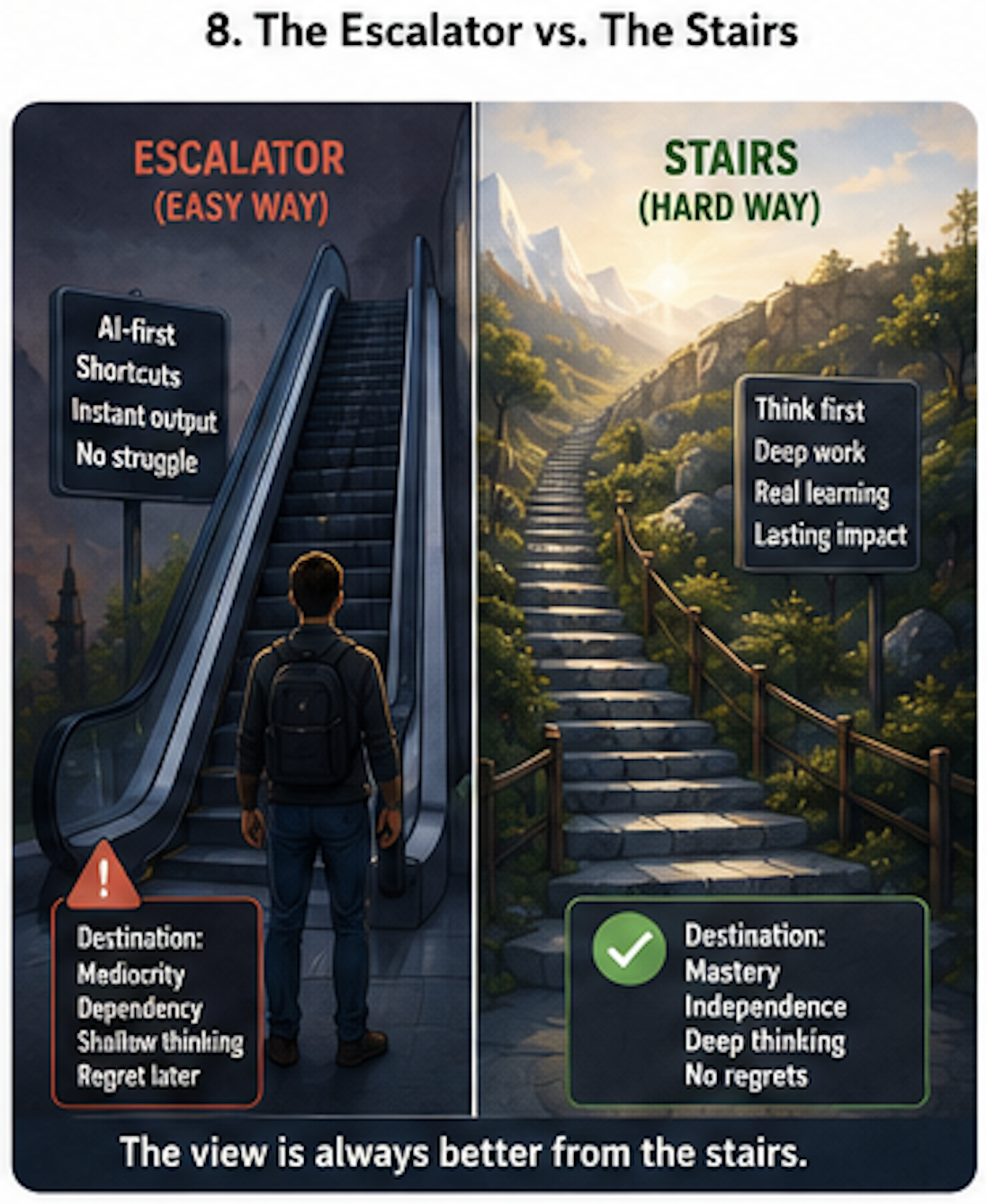
And remember — if you're reading this at 25 or 35 or 45, you're not late. The second half of life is the longer half, and it can be the better half. The only thing stopping you is the same thing that stopped those people at the broken escalator: the belief that the easy way is the only way.
Think outside the bot.
Be future-proof.
If this resonated with you, share it with someone who's running five AI tabs right now. They probably won't read it — but that's exactly the point.
References
[1] Kosmyna, N., et al. (2025). "Your Brain on ChatGPT: Accumulation of Cognitive Debt when Using an AI Assistant for Essay Writing Task." MIT Media Lab. arXiv:2506.08872.
[2] BBC Future (2026). "Think outside the bots: How to stop AI from turning your brain to mush." Featuring Prof. Adam Green, Georgetown University.
[3] Kanter, B. (2025). "Staying Sharp: Practical Strategies for Preserving Cognitive Skills in the Age of Generative AI." Philanthropy.org.
[5] Gerlich, M. (2025). "AI Tools in Society: Impacts on Cognitive Offloading and the Future of Critical Thinking." Societies, 15(1), 6. DOI: 10.3390/soc15010006.
[6] Wilson, T.D., et al. (2014). "Just think: The challenges of the disengaged mind." Science, 345(6192), 75–77.
[7] Gailliot, M.T., et al. (2007). "Self-control relies on glucose as a limited energy source." Journal of Personality and Social Psychology, 92(2), 325–336.
[8] Shannon, O.M., et al. (2023). "Mediterranean diet adherence is associated with lower dementia risk." BMC Medicine, 21, 81. (60,298 participants, UK Biobank.)
[9] Ballarini, T., et al. (2025). "Mediterranean diet and Alzheimer's risk: a meta-analysis." GeroScience. (23 studies.)
[10] Pfeifer, V. & Mehl, M.R. (2026). Perspectives on Psychological Science. University of Missouri-Kansas City / University of Arizona.
[11] Roediger, H.L., & Karpicke, J.D. (2006). "Test-enhanced learning." Psychological Science, 17(3), 249–255.
[12] Ebbinghaus, H. (1885). Über das Gedächtnis (On Memory). The forgetting curve.
[13] World Economic Forum (2025). Future of Jobs Report. LinkedIn (2024). Most In-Demand Skills Report.